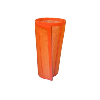
The hardness of wear-resistant polyurethane components is a critical indicator of a material's resistance to compression and indentation; it is typically expressed using the Shore hardness scale (Shore A or Shore D)*. Polyurethane materials exhibiting greater elasticity are commonly characterized by Shore A hardness, typically falling within the 60A to 95A range. Conversely, components requiring superior wear resistance and rigidity utilize Shore D hardness, generally ranging from 20D to 50D. Hardness measurements are typically performed using a standard durometer, which assesses the material's resistance to indentation by pressing an indenter of a specific size into its surface. The higher the hardness, the greater the material's resistance to abrasion and its load-bearing capacity, though its elasticity may be slightly reduced.
The selection of hardness for wear-resistant polyurethane components directly impacts their operational performance. Components with higher hardness are suitable for high-impact and high-abrasion environments-such as those found in mining crushers and ball mill liners-where they effectively extend service life. Conversely, components with lower hardness are ideal for applications requiring shock absorption, equipment protection, or the handling of fragile materials-such as the slotted decks of vibrating screens and hopper liners-as they help minimize material breakage and equipment wear.